Enjoy this fantastic French documentary called Latcho Drom (“safe journey”) that brings a little insight into the journey of the Romany people through musicians and dancers (there is very little dialogue). I love how the musical sound and styles have evolved as the communities have wandered from India, to Egypt, Turkey, Romania, Hungary, Slovakia, France, and Spain.
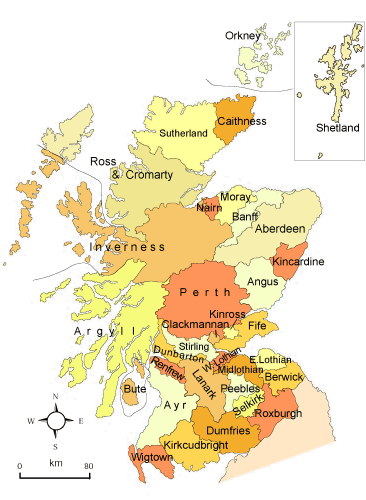
Radio 4 often has some wonderful programs telling the stories behind the music – today there was a program by Julie Fowlis an acclaimed Hebridean musician and singer, talking about a project that is collating the amazing stories and musical heritage in Scotland. Tobar an Dulchais (translated as “a well of heritage”) is an incredible online resource which has been set up to preserve recordings in Scots, Gaelic and many other local dialects. At the moment they have a catalogue of 30,000 songs, music, stories and poetry which have been recorded since the 1930’s all over Scotland – all of which you can listen too online.
We often use maps of the world to encourage people to discuss perspective – all maps are saying something but often it is not what we think they are saying. You have to know what the cartographer is trying to depict to really understand the map. Also as time moves on we learn more and can ask questions behind why we might have done things a certain way in the past eg for political reasons. Here’s a fun clip from a TV episode that looks at this conundrum.
Interestingly whilst on a recent flight I read about “trap streets” – apparently cartographers for centuries have misnamed streets or made up new ones for the sole purpose of catching those who copied or reprinted maps as their own. The London A-Z was reported to have more than 100 trap streets by the mid 2000’s. This you will be pleased to know is now a dying art!
Heard about a wonderful social enterprise project called the Nozumi project in Japan. Using broken shards of pottery and recycled material found amongst the debris of the 2011 tsunami, a group in Ishinomaki are making unique jewelry to help their community.
“Nozomi, translated ‘hope’ in Japanese, is a social enterprise bringing sustainable income, community, dignity and hope to the women in Ishinomaki, Japan by training women to craft unique jewelry products. One third of these women are single mothers and grandmothers; most of these women and their family members lost their livelihood when the tsunami crashed through half of their city in 2011.”
This made me smile – Russia enjoys the flash mob phenomenon.
A Persian warrior who was marching to battle was carrying a bow but no arrows. On the road he met a friend who asked why he had brought no ammunition. “How will you fight?” asked his friend. “I will use the arrows sent by the enemy,” he replied. “But what if no arrow comes?” “Then” replied the bowman, “there will be no war”.
Interesting that the trials of Khmer Rouge leaders is happening the week that Garlands for Ashes has been released. Check out this article and this video from the BBC
One of the few traditional instrument players that survived the Khmer Rouge genocides.
Interesting clip from Cambodia about the resurgence of Khmer arts.
“There has been a revival of traditional and contemporary arts across the country and Phnom Penh has become a hotbed of creativity and young talent. Michelle Jana Chan travelled to the capital to look at this resurgence.”
A UN-backed tribunal in Cambodia is holding its first hearing in the trial of four former top Khmer Rouge leaders.